Mgr Paul Grogan

Mgr Paul Grogan
Mgr Paul Grogan

Friday, 25 January 2013

Celebrating Education Sunday


We wished to celebrate Education Sunday somehow (which the churches in England and Wales are marking this coming Sunday) given that Leeds Trinity was founded to provide teachers for Catholic schools and teacher training remains core to our identity. A couple of years ago we had an ecumenical service but it was poorly attended. So this year we adopted a different approach: we set up a table with free coffee, fruit juice, cakes, scones and biscuits in a corridor in the building where many of the Primary Education students have their lectures. Cohort after cohort descended upon it delightedly. "What is this all free?" asked one incredulously. "You're worth it," we said. "Today is all about celebrating everybody involved in education." Then when their sugar levels were restored and they were preparing to return to lectures we gave them information about future Chaplaincy events, a prayer to mark the day, and a description of the vocation of the teacher taken from the Education Sunday website. St Paul, the feast of whose conversion is today, travelled throughout the known world to evangelise; we just asked the unversity porters to transport some flasks of coffee and cakes to a building three minutes' walk from the Chaplaincy. Nevetheless, the effect was dramatic. Many students are so pressed for time they don't want to attend a social event in the Chaplaincy; and some fear that they might be labelled were they to do so. So the Chaplaincy needs to go them. It's rather embarrassing that it's taken me five-and-a-half years to realise this. It occurred to me that Jesus' words in today's gospel - "Go out to the whole world" - do not constitute an injunction for a time, as if there could be a moment when the job had been done and we could all relax. "Going out" is a permanent feature of the life of the Church; it is what the Church is for.

Speaking of Jesus

Our Taize Service to mark the Week of Prayer  for Christian Unity unfolded serenely this evening. Sr Anne Hammersley cp, the Assistant Chaplain, had prepared everything meticulously. A band from Cragg Hill Baptist Church in Horsforth provided the music and the singing. We were able to join in the wonderful chants and to inhabit the silences which followed them. The focus of the semi-circle of chairs at the front of the chapel was a large red painted crucifix, bearing a giant Christ and alongside him the much smaller figures of Mary and the Beloved Apostle, whose gestures showed that they had now stepped beyond history and were petitioning Jesus on our behalf. We joined in their prayers. We had made the cross our own, lighting red candles placed around its borders and laying alongside it crosses of twigs that we had fashioned, representing the personal suffering of each. Afterwards, a Baptist woman remarked on how powerful she found the crucifix in our chapel. She is used to seeing an empty cross which for her expresses the reality of Christ's resurrection, but looking at a crucifix helps her to understand the depths of Christ's love. What a felicitous exchange for us to have during a week such as this! Over the supper, during which local Christians mixed with students - and which consisted of spicy red kidney bean soup, chicken pieces in a honey and grainy mustard glaze, lamb tangine, rice and a vegetarian pizza - we talked, as usual about all sorts and then suddenly, on my sofa, the conversation switched to a consideration of Jesus in his humanity and no sooner had that drawn to a close than I heard the word "Jesus" in a conversation on a nearby sofa. The very mention of Our Lord's name elevates such a social occasion, gives it very naturally a new character. We mention "Jake" and "Luke" and "Sue" and everybody knows of whom we talk. For believers, to utter Jesus' name is always a charged speech event: we are clearly not just talking about a historical personage; we are talking about somebody we know. Jesus' presence in our lives has become more real to us because we have just dared to name him and to speak of him as we do of a friend.

Here is the very generous kitchen team for the evening: Hannah, chopping, Naomi, peeling, Laura, pouring, Meghan, opening and Matt, grinding.


Wednesday, 23 January 2013

A marvellous historic evening


When James Hanson - who until three years ago was stacking shelves at the Coop - side-stepped his Dutch international marker and headed a corner decisively into the roof of the net in the second leg of the League Cup semi-final at Villa Park this evening, it was difficult to take in the historical significance of the moment. I have supported Bradford City ever since I was six; my father would take me and my two brothers to home games. We bonded over programmes, Bovril, meat pies and occasional instinctive leaping upwards together in delight in a line, scarcely believing that something as beautiful (and often, frankly as unlikely) as a Bradford goal could have been brought into existence before our very eyes. I remember in 1976 watching Southampton knock us out of the FA cup semi-final with a Jim McCalliog free-kick which Jimmy Hill informed the nation on Match of the Day that evening had been illegal. Our emotional bond to the club deepened as a result of the Bradford fire in 1985 when many supporters were killed, a match which my father and my elder brother attended. After a hard two years in the Premiership more than a decade ago, Bradford has plummeted, finishing at a lower position than the previous season almost every year. Twice the club has gone into liquidation; once the players had to play for no wages. Now I go three or four times a year. I last went at the end of last month when Rochdale beat Bradford four two; the Bradford team was sluggish and unimaginative on that occasion. "Oh, I'm glad that's over," said a season ticket holder sitting beside me with feeling.

When the team, which is in the fourth tier of the league, played so poorly in the first half of this evening's League Cup tie against Premiership team Aston Villa and conceded a goal, I was not surprised therefore. Apparently, one Villa player earns more than the entire Bradford team put together. I was watching the match in a pub in Horsforth. Then in the second half the Bradford players tentatively acquired a new self-belief. It looked to me that a good number of them had simply been overawed in the first 45 minutes. Now their play was fluid, they moved into postion rapidly to offer passing chances and their forwards surged towards the Villa defenders self-confidently. It didn't matter that they were not as consistently skillful as their opponents. They had put fear aside and suddenly they were a force to reckoned with, at least during some periods of play.  In the event they lost two one but now go through to the final on aggregate. What makes football, and indeed any team sport, so enduringly good to behold, I think, is because it has both an aesthetic dimension, for example, precise coordination of  movement, and a moral dimension, most particularly, through the opportunities which it affords for players to grow in the virtue of fortitude. Blessed John Paul understood this well. Bradford last won a final in 1911: they beat Newcastle in the FA Cup. They will now play Chelsea or Swansea in the League Cup final at Wembley. I hope to be there.

Monday, 21 January 2013

Listening to God

I often supply in parishes on Saturday evenings and Sunday mornings and preach on vocation to the priesthood. Yesterday I was at two of the very few churches in the diocese that I have not previously visited: St Joseph's, a small, plain, red-brick chapel-of-ease in Cross Hills, near Skipton which was built in 1920; and Our Lady of Mount Carmel, Silsden, a former Methodist church which the diocese acquired in 1957. Members of the both congregations greeted me very warmly. I feel energised by this preaching mission. I generally preach about the priesthood from two perspectives, namely that it is a gift to everybody in the Church, and indeed in the world; and that the priest, through the celebration of the Eucharist, unites the people (or, perhaps better, Christ unites them through the priest's ministry), freeing them to fulfil their own vocations in the secular sphere. Each homily is based more particularly on the readings of the day. It's not a recruitment drive - the homily is not the place for that. It's rather a mission to encourage the people of the diocese, to let them know that we have some seminarians - eleven at the moment - and that God will not let us down and to encourage them to pray for more vocations to the priesthood in the future. Of course, I always harbour the hope that a young or middle-aged man in the congregation may be moved to offer his life to Christ in this way at that moment, but I have been engages in this mission now for about eight years and nobody has ever said to me: "It was your words that did it, Father." However, we just don't know how the Holy Spirit will use our preaching for his purposes. I do recall that when I was a boy it seemed that priests were frequently underlining the importance of vocations to the priesthood and that, certainly as a teenager, I used to feel excitement and alarm in equal measure when listening to them. Jesus, who turned water into wine, calls men in every generation to this extraordinary ministry and I have been given the job - or more truly Christ has given me the job, through and under the bishop - of encouraging men to listen to what God is saying to them in their depths. To say that I love it would be an understatement!

Here's a picture of the interior of Our Lady of Mount Carmel whose sanctuary has recently been renovated.

Talking about Christ as we walk

We had a pleasant day half-day's walk in the environs of Poole in Wharfedale yesterday, which is just about a quarter of an hour's drive from Leeds Trinity. Eight students and a Religious Studies lecturer joined me in tramping across six-and-a-half miles of snow-covered fields, our feet breaking through the thin ice and squelching into the thick mud beneath. We saw a hare haring across a distant slope and an unidentified bird of prey wheeling above us. People toppled over, got temporarily stuck on tricky stiles; and we all laughed at each other's misfortunes. One young woman had bought some wellington boots for the occasion, discovered that they were both for the left foot, but pressed on uncomplainingly regardless! Everybody was just pleased to be out in the open air with a gang of friendly people and to have the opportunity to relax. As a priest these are golden moments: you have good conversations, one after another, building up relationships. Often the fact that you are facing the same way as your interlocutor helps enormously. Stuff gets sorted as you tramp along. At one point we saw the picturesque Almscliff Crag in the distance where, I understand, some local churches have a dawn service on Easter morning before heading off to have separate services in their own buildings. I read once, I believe, that John Wesley preached to a large group of people from that crag. At least one of our party yesterday was a Methodist. Just about all of us were Christians, it turned out. It occurrred to me as we pressed on good humouredly that the continuation of the faith in this island, claimed for Christ by Columba and Augustine, is not really in jeopardy. Many young people believe in Christ. Some are keeping their heads down, nervous of being accused of being bigots by their contemporaries. That's what made yesterday so delightful: students could refer to their Christian faith now and again as the conversations progressed unselfconsciously. Sometimes it's good to be yeast in the world; but at other times we need simply to be together, drawing strength from each other. The day ended with hot chocolate in a pub and then cups of tea back and Jaffa Cakes in the Chaplaincy Lounge. It's impossible to calculate the blessings of such shared time.

Here is a picture of us all taking a pause at a farm.


Saturday, 19 January 2013

Ecumenism and Dodgeball

We had a good service to mark the beginning of the Week of Prayer for Christian Unity today. My colleague, The Reverend Dr Jane De Gay, an Anglican, who is also a senior lecturer in the English Department, preached powerfully. She concluded by saying that Christ has given those of us who are baptised a common identity by clothing us with himself, quoting the line from Galatians 3 which was one of the designated readings. It was very refreshing to consider the grounds of our unity in this way eg not simply in terms of our commonality of belief (I always become uncomfortable when people minimise the significance of doctrinal differences; doctrines matter to all committed Christians) but rather in terms of an act of Christ: he has already made us members of his Church. Once we acknowledge that, as we have to after Lumen gentium, the Vatican II document about the Church, to maintain a default position of defensiveness and aloofness is not just daft, contrary to the will of Christ and insulting to those whom we recognise as our brothers and sisters, it's exhausting. I've learnt this especially through my five-and-a-half years at Leeds Trinity.  There is only a small core group of "in-your face" Christians among the members of staff and I know that my ministry would be extremely demanding if I wasn't able to count on their support. They have helped me to think outside the frame of reference provided by the Reformation and I must say I feel much the better for it!

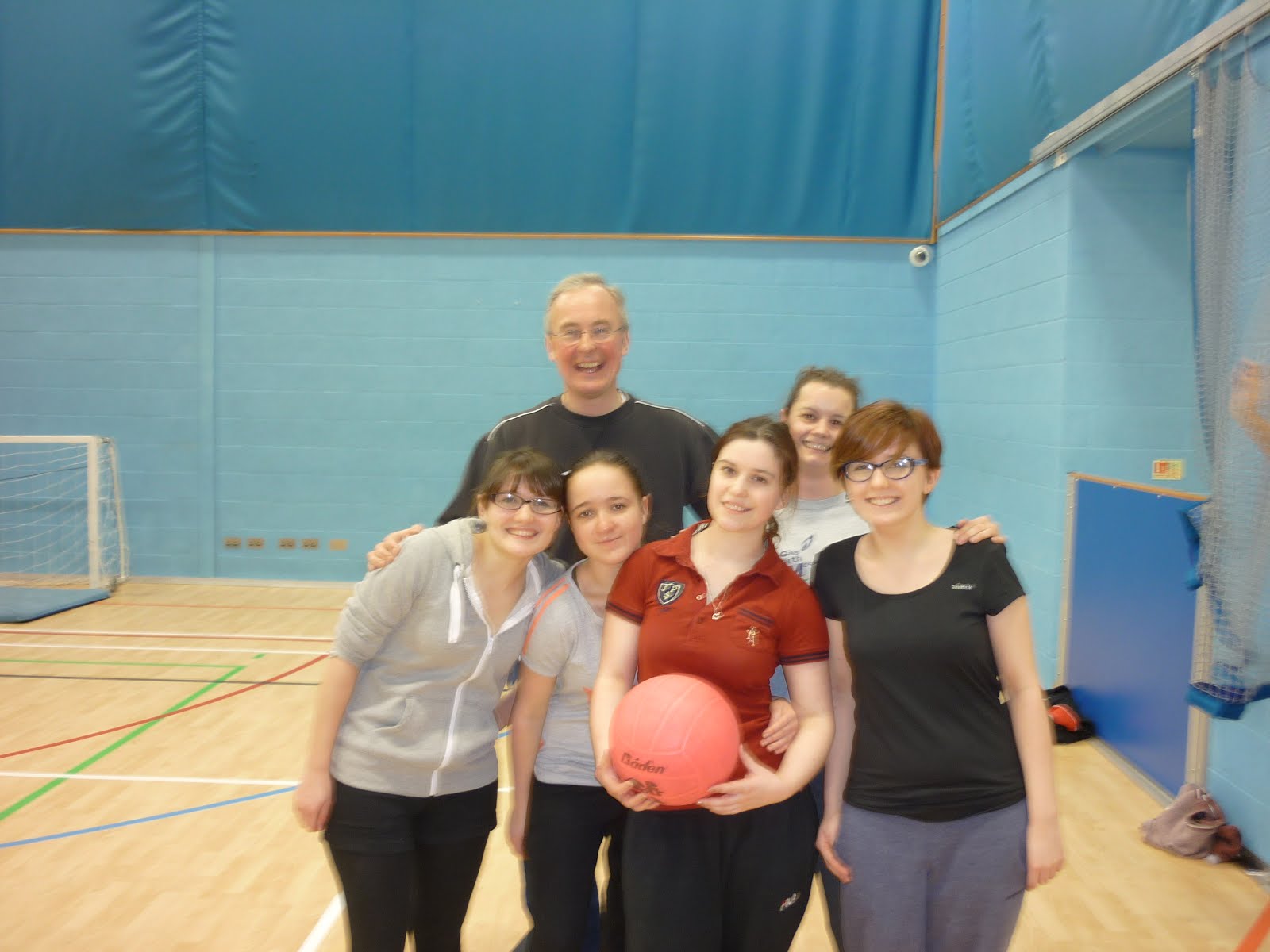
Just after our lunch of Indian soup and naan bread and dips (the text of the service was provided by Churches Together in India) two female students burst into the Chaplaincy Lounge and exclaimed together: "You've got to come! We need an extra player for Dodgeball!" The sports development department had organised a lunchtime tournament of this sport (which I had never heard of before) and we were fielding two Chaplaincy teams. Dressed in tracky bottoms and a tee-shirt I ran on to the court with my five team-mates, not fully aware of the rules but determined to give it my best and then the opposing side bombarded me with balls and, within a few seconds, I had been eliminated.

That was bad enough but worse was to follow. Owing to the Christian Unity Service I was unable to attend a career's day at St Wilfrid's Catholic High School, Featherstone, where I was to have regaled the children with stories about my priesthood. Fr Michael Doody, our youngest priest, who recently kindly agreed to become a member of a three-priest vocations promotion team, went in my stead. "Was he all right?" I asked the lay chaplain who helped organise the event on the telephone this evening. "Oh, he was great, perfect. He spoke to three groups for twenty minutes each and then he spoke to a class for a whole hour. They were hanging on his every word. Can we have him again next year?"

Here's a picture of me and my team-mates. We lost every match, but we remained resilieintly cheerful.


Thursday, 17 January 2013

The Yorkshire Dales: doorway to the sacred


As I worked up a sweat on an exercise bike in the Leeds Trinity gym this evening, I heard on the television Monsieur Christian Prudhomme, chief of the Tour de France, praise my home county. "I knew Yorkshire before but I did not realise that it was so gorgeous. Really!" He was speaking as it was announced that this famous race is to have three legs in Britain, the first of which is to navigate my Monday, day-off playground: Wharfedale and contiguous dales. I have always intuited that this region probably contains the most perfect landscape of anywhere in the world. I remember when I was a young boy sitting in the back of the family Wolsey as we drove from Burnsall to Grassington and Harry Myers, an elderly friend of my father's, sitting in the front, revealed that as a Bradford wool merchant he had travelled a lot, going even as far as Russia, but that he had never seen anywhere to compare with the countryside through which we were then passing. I made a mental note to remember that I was incredibly fortunate that God had not only conferred life on me, given me a loving family, and granted me membership of his Catholic Church, but that he had also caused me to grow up on the edge of the Dales. Burnsall, the head of Wharfedale, was to me like Galway was for centuries to others, the furthest point of the known world, and all beyond lay in mystery. I recall the moment we penetrated beyond Burnsall, over the high pass into Bishopsdale, and I was filled with a sense of unfolding possibilities, geography stirring my spirit, opening me up to the transcendent, to the Creator, to the Creator of me. Now when I stride those fells - usually alone, and happy to be so - I recall moments I enjoyed there when I was younger with members of my family and then everything that has happened since becomes properly contextualised: I am a son; I am a brother; and only afterwards am I a priest. Sometimes whole Mondays elapse on the hills without me seeing another person. Now in my mind's eye, like a moving image taken from a helicopter, I see Simon's Seat above Appletreewick, the attaining of which literally takes once's breath away, so sharp is the buffetting wind which assails the ridge; I see the steep winding path on the west fell above Kettlewell where I have taken parties of students from here, their protests muted by their exhaustion; and the path winding up the east fell to Great Whernside, just beneath the summit of which is the highest chapel in Britain, next to a scout hut, outside of which, as a young priest, I heard first confessions of some of the children of our parish while the scout leaders looked on, delighted by the juxtaposition of natural beauty with sacramental symbolism and child-like innocence, as near a reclaiming of Eden as is possible in history (one took photographs, I remember).  I had to laugh last week when I was on holiday in Pembrokeshire with two priest friends. On one of our walks, one of my friends, himself a Yorkshireman, expressed his pleasure at the surrounding scenery and then, after a pause, concluded, "It's like Yorkshire, actually," while our other friend, from Hampshire, spluttered his protests at the reduction of everything to a single template.